Samsung C&T and Hitachi Energy Extend Partnership to Europe
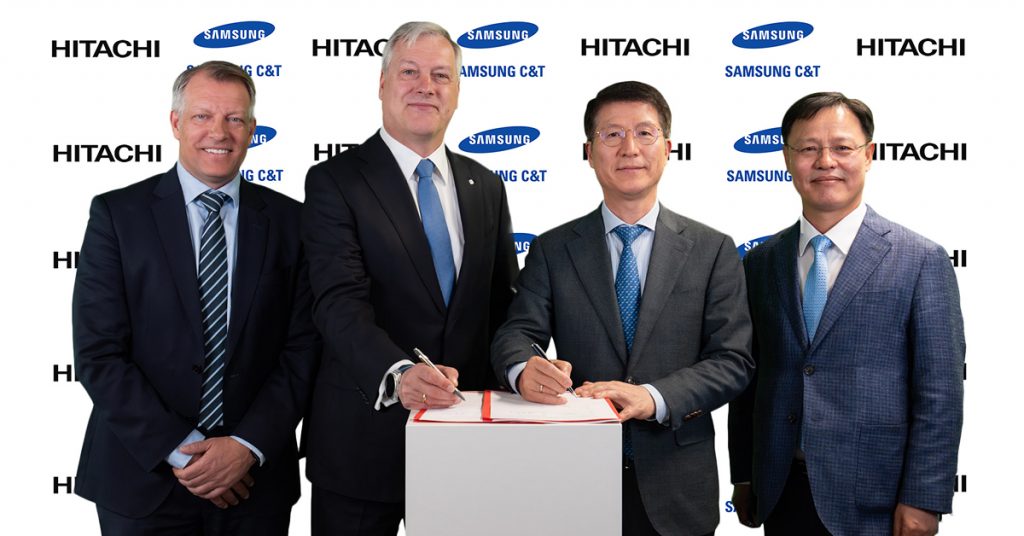


Samsung C&T Engineering & Construction (E&C) Group and Hitachi Energy signed a Memorandum of Understanding (MoU) on 13 April 2026 at Hitachi Energy's headquarters in Zurich, Switzerland, extending their strategic partnership to cover high-voltage alternating current (HVAC) infrastructure and formally targeting the European power grid market.
Scope of the Agreement
The MoU builds on an earlier strategic partnership signed by the two companies in October 2024, which was focused on joint pursuit of HVDC projects worldwide, with an initial emphasis on the Middle East, Southeast Asia and the Republic of Korea. The new agreement broadens the cooperation to include HVAC technologies and establishes a joint framework for European power grid projects, covering aligned AC market prospects, a shared go-to-market roadmap and a joint opportunity pipeline.
Under the partnership, Hitachi Energy contributes its grid technology, engineering, electrical systems and digital solutions, while Samsung C&T provides its engineering, procurement and construction (EPC) delivery capability. The companies have stated that HVDC and HVAC technologies are complementary, with HVDC suited to long-distance, high-capacity and subsea transmission and cross-border interconnection, and HVAC underpinning the stable operation of existing grids.
European Market Drivers
The companies cited rising electricity demand across Europe from mobility, industry and data centres, combined with the increasing integration of variable renewables, as the main drivers of the agreement. Flexibility and efficient transmission, alongside cross-border electricity exchange, were highlighted as areas where AC solutions are expected to play a growing role in parallel with DC.
Existing Joint Projects
Samsung C&T and Hitachi Energy are already working together on Project Lightning, a subsea power project supplying clean electricity to offshore facilities operated by ADNOC in the United Arab Emirates, comprising two HVDC links delivering a combined 3,200 MW.
The two companies are also jointly involved in Marinus Link, a 750 MW HVDC interconnector between Tasmania and Victoria in Australia. Hitachi Energy was contracted in May 2024 to supply HVDC Light voltage source converter stations for Marinus Link Stage 1. In December 2025, Samsung C&T announced it had secured a KRW 470 billion share, through a joint venture with Australian contractor DT Infrastructure, of the civil works package covering underground cable installation and converter station construction.
Company Context
Hitachi Energy, headquartered in Switzerland, has more than 100 years of experience across high-voltage systems, transformers, grid automation and power electronics, with installations in more than 140 countries, around 50,000 employees across 60 countries, and revenues of approximately USD 16 billion. The company has been active in HVDC for more than 70 years.
Samsung C&T E&C Group has 50 years of international project experience across commercial and residential buildings, civil infrastructure and plant construction, with landmark projects including the Burj Khalifa in the UAE, the Petronas Towers in Malaysia, the Riyadh Metro in Saudi Arabia and the 5,600 MW Barakah Nuclear Power Plant in the UAE.
Signatories and Statements
The MoU was signed in the presence of Oh Se-chul, President and CEO of Samsung C&T Corporation's Construction Division, and Andreas Schierenbeck, CEO of Hitachi Energy, alongside Niklas Persson, CEO of Hitachi Energy's Grid Integration Business Unit, and Byung-soo Lee, Executive Vice President and Head of Global Business Development at Samsung C&T.
Byung-soo Lee said the collaboration model proven in the UAE and Australia would serve as a competitive advantage in global power infrastructure markets including Europe, and that the companies would continue to pursue complex cross-border transmission projects using integrated AC and DC solutions. Niklas Persson said Europe is entering a pivotal period for the energy transition, adding that resilient AC grid infrastructure is foundational to accelerating grid modernisation, strengthening system resilience and supporting large-scale renewable integration.
.jpeg)