India Issues Pre-Bid Tender for Barmer–South Kalamb HVDC Link


Power Grid Corporation of India Limited (POWERGRID) has issued a pre-bid tender for Package-I of the Barmer HVDC Power Transmission scheme, a ±800 kV, 6,000 MW LCC-HVDC project that will evacuate solar energy from the Barmer Complex in Rajasthan to South Kalamb in Maharashtra. The tender document sale opened on 10 March 2026 and closes on 30 March 2026, with bids due for submission by 1 April 2026.
The pre-bid arrangement allows prospective contractors to form consortiums ahead of POWERGRID's formal Request for Proposal (RfP) submission to the Barmer Project Company (BPC), the project special purpose vehicle. Procurement follows the Tariff Based Competitive Bidding (TBCB) route, with REC Power Development and Consultancy Limited (RECPDCL) serving as bid process coordinator. The tender fee is INR 25,000, with no Earnest Money Deposit required.
Project scope
The scheme, formally titled "Transmission system for evacuation of power from Rajasthan REZ Phase-IV (Part-5: 6 GW) [Barmer Complex]" forms part of India's wider programme to evacuate renewable energy from Rajasthan's high-density solar zones. The state has been identified for up to 75 GW of renewable energy capacity, with the Barmer and Fatehgarh complexes accounting for a combined 13 GW of planned evacuation.
Package-I covers the HVDC terminal infrastructure and associated AC works. The core elements of the full scheme include:
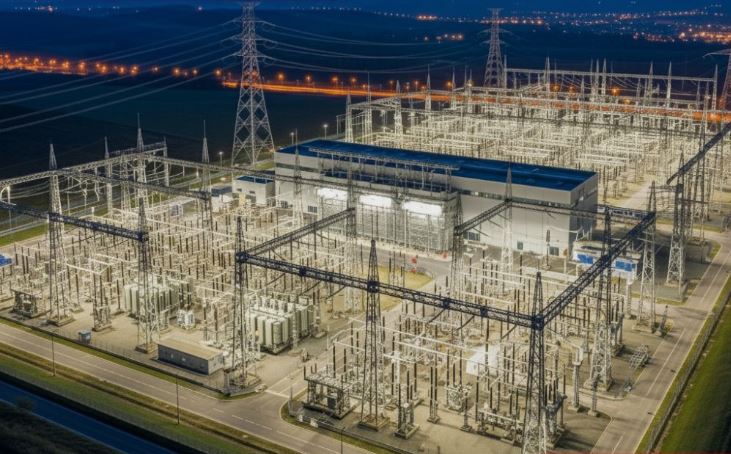
- A new 6,000 MW, ±800 kV Barmer-II (HVDC) LCC terminal station, configured as four 1,500 MW units, to be located near the Barmer-II pooling substation in Rajasthan
- A corresponding 6,000 MW, ±800 kV South Kalamb (HVDC) LCC terminal station (4×1,500 MW) in Maharashtra
- An ±800 kV HVDC bipole line (Hexa Lapwing conductor) connecting the two terminals, with a running length of approximately 900 km
- A new 400/220 kV, 6×500 MVA AIS pooling substation at Barmer-II
- A 400 kV double-circuit quad line connecting Barmer-I and Barmer-II pooling substations
- Two 400 kV synchronous condenser (SynCon) units at Barmer-II, to address system strength concerns at the AC network feeding into the HVDC converter
The total estimated project cost is Rs. 24,974 crore (approximately USD 2.9 billion). The first HVDC pole is required to be commissioned within 48 months of the zero date, with the second pole following six months later. Bidders are required to furnish a bid bond of Rs. 2.86 billion and a contract performance guarantee of Rs. 7.16 billion.
Technology selection
The decision to proceed with LCC technology followed a detailed cost analysis conducted by Central Transmission Utility of India Limited (CTUIL) at the direction of the National Committee on Transmission (NCT). CTUIL evaluated three alternatives — LCC-HVDC, VSC-HVDC, and a battery energy storage system (BESS) — and concluded that LCC represented the lowest capital cost option. LCC was estimated at approximately Rs. 26,500 crore, compared with around Rs. 38,000 crore for VSC, while a BESS solution sized at 6 GW × 4.25 hours was found to be more expensive than initially projected. NCT formally approved LCC technology at its 30th meeting, held on 30 May 2025, and the Ministry of Power notified the scheme via Gazette Notification in August 2025.
Despite opting for LCC on this occasion, NCT directed CTUIL to develop specifications that would enable technology-agnostic bidding for future HVDC schemes, and to carry out further cost-benefit analysis comparing BESS with HVDC alternatives on an ongoing basis.
Broader context
The Barmer scheme is the latest in a series of large HVDC projects being developed through the TBCB framework to integrate India's expanding renewable generation base with load centres further east and south. POWERGRID has been an active participant in this pipeline: in February 2026, India's Cabinet approved an increase in the equity investment threshold for POWERGRID subsidiaries from Rs. 5,000 crore to Rs. 7,500 crore, enabling the utility to take part in capital-intensive HVDC bids. POWERGRID also holds the letter of intent for the Khavda V-A HVDC transmission scheme, estimated at close to Rs. 25,000 crore.
The Barmer–South Kalamb link is regarded as one of the largest single TBCB transmission projects currently under active procurement in India, and among the most significant LCC-HVDC tenders anywhere in Asia in the current cycle.