Hitachi Energy Wins ELMED Converter Station Contract
.jpg)


Terna, the operator of Italy's national electricity transmission grid, and STEG, the Tunisian electricity and gas operator, have awarded Hitachi Energy a contract worth approximately €770 million ($875 million) for the construction of the converter stations for the Elmed project, the first electricity interconnection between Italy and Tunisia.
The award marks the completion of the procurement process for what will be the first high-voltage direct current (HVDC) submarine link between Europe and North Africa. The tender, published jointly by Terna and STEG in 2023 in the Official Journal of the European Union, covered the design, supply, and construction of the converter stations for the interconnection. The link is one of the infrastructure projects included in the Mattei Plan for Africa, intended to strengthen economic, energy, and geopolitical partnerships between Europe and African countries.
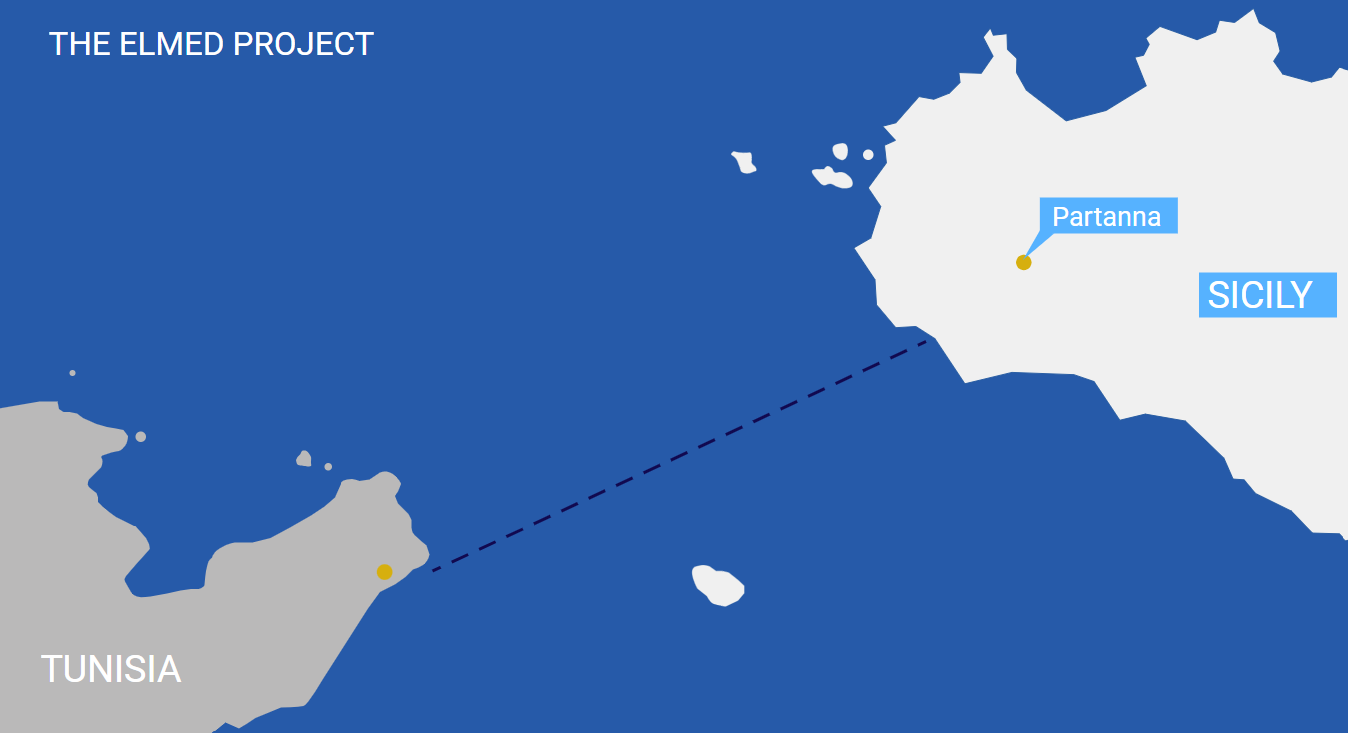
The two converter stations will be built in Partanna, in the Sicilian province of Trapani, and in Mlaabi, in the Menzel Temime area on Tunisia's Cape Bon peninsula. The interconnection will have a capacity of 600 MW and a DC voltage of 500 kV, extending for about 220 km, predominantly via submarine cable across the Strait of Sicily, reaching a maximum depth of around 800 metres. The power line is designed as a monopole with sea return.
Hitachi Energy is responsible for providing the HVDC solution, drawing on its HVDC converter valves, its MACH digital control platform, power transformers, and high-voltage switchgear, as well as system studies, design and engineering, supply, installation supervision, and commissioning. Other companies in the consortium will mainly carry out civil works alongside electromechanical installations and auxiliary systems, with D'Agostino Costruzioni Generali S.p.A. handling the Partanna station and Orascom Construction SAE the Mlaabi station.
The total investment for the electricity link is €1,420 million. Of this, €307 million has been allocated by the European Commission through the Connecting Europe Facility (CEF) grant programme managed by CINEA. It is the first time the European Union has financed a project involving a non-member country. The project is also supported on the Tunisian side by additional European and international financial institutions, including the World Bank, the European Investment Bank, the European Bank for Reconstruction and Development, and KfW.
Elmed is positioned as a major infrastructure project for strengthening energy security and integrating the electricity systems of Europe and North Africa, in line with the objectives of the Integrated National Energy and Climate Plan (PNIEC). The project enjoys the full support of the Tunisian authorities and forms part of a national vision aimed at strengthening energy security, promoting the regional integration of electricity markets, and supporting the energy transition. It also supports the dual objective of the European Commission's REPowerEU plan: ending the EU's dependence on fossil fuels and achieving decarbonisation targets through diversifying energy supplies and developing renewable energy.